

1. Where is Glacier National Park located?
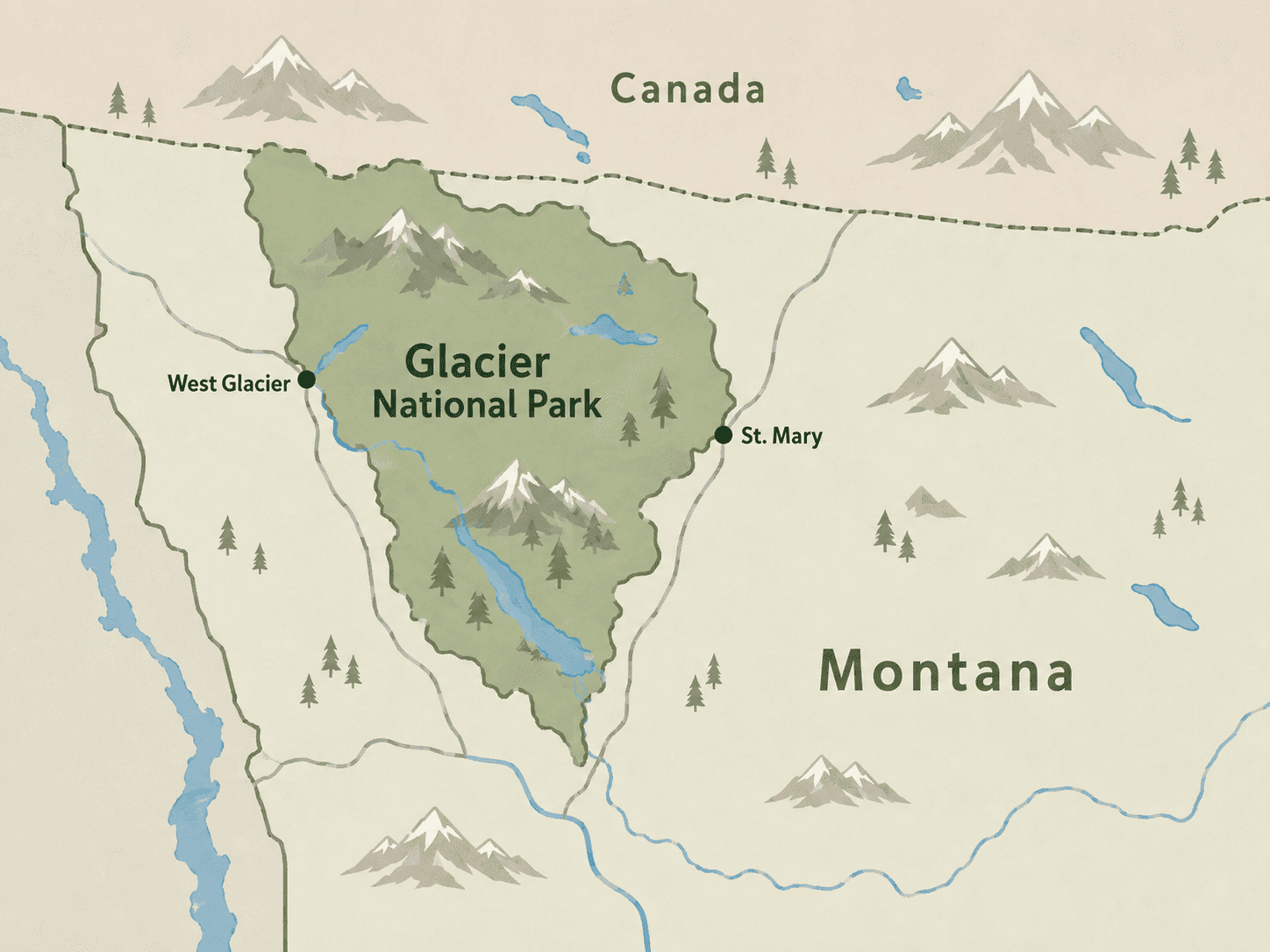
Glacier National Park is located in the far northwest corner of Montana, along the Canadian border, roughly two hours north of Kalispell and Whitefish. The park sits within Flathead and Glacier counties and straddles the Continental Divide in the Rocky Mountains.
The nearest sizable city is Kalispell, about an hour's drive from the park's West Entrance. Two smaller gateway towns, West Glacier and St. Mary, sit directly at the park's west and east entrances.
2. What state is Glacier National Park in?
Glacier National Park is entirely within the state of Montana. It occupies the northwestern part of the state, directly south of the Canadian province of Alberta and British Columbia.
The park's location on the Canadian border is part of what makes it unique: it connects directly with Waterton Lakes National Park in Canada, and the two together form the Waterton-Glacier International Peace Park (more on that below).
3. How big is Glacier National Park?
Glacier National Park covers just over 1 million acres (about 1,583 square miles / 4,100 km²). That makes it one of the largest national parks in the contiguous United States, though noticeably smaller than Yellowstone.
|
Park |
Acres |
Square Miles |
|
Glacier National Park |
~1,013,000 |
~1,583 |
|
Yellowstone National Park |
~2,219,000 |
~3,468 |
|
Yosemite National Park |
~759,000 |
~1,187 |
Within that area, Glacier contains more than 130 named lakes and hundreds of unnamed ones, along with over 700 miles of hiking trails.
4. How many glaciers are left in Glacier National Park?
As of the most recent USGS survey, 25 named glaciers remain in Glacier National Park, down from an estimated 150 when the park was established in 1910.
The decline is driven by rising temperatures: glaciers here have lost significant mass since the mid-1800s, and researchers have tracked the shrinkage using aerial surveys since the 1960s. Earlier predictions suggested the park could be glacier-free by 2030, though scientists now describe that specific date as an oversimplified estimate — the underlying trend of rapid loss, however, is well documented and ongoing.
5. When was Glacier National Park established?
Glacier National Park was established on May 11, 1910, when President William Howard Taft signed it into law, making it the United States' tenth national park.
The push to protect the area took nearly two decades and was led largely by naturalist George Bird Grinnell, often called the "Father of Glacier National Park." The Great Northern Railway later built much of the park's early infrastructure, including the historic Many Glacier Hotel and Lake McDonald Lodge, both of which are still operating today.
6. What's the closest airport to Glacier National Park?
The closest airport to Glacier National Park is Glacier Park International Airport (FCA) in Kalispell, Montana, about 30 miles (roughly 40-45 minutes) from the park's West Entrance.
|
Airport |
Distance to West Entrance |
Best For |
|
Glacier Park International (FCA), Kalispell |
~30 miles |
Most visitors, especially West Glacier / Whitefish |
|
Missoula Montana Airport (MSO) |
~140 miles |
Lower fares, more flight options |
|
Great Falls International (GTF) |
~150 miles |
East-side plans (St. Mary, Many Glacier, Two Medicine) |
|
Calgary International (YYC), Canada |
~230 miles |
Combined trips with Waterton Lakes, Canada |
FCA runs year-round direct flights from hubs including Seattle, Denver, Salt Lake City, and Minneapolis, with additional seasonal routes in summer.
7. How far is Glacier National Park from Bozeman, Kalispell, and Missoula?
Kalispell is the closest of the three, at about 30 miles (40-45 minutes) from the West Entrance. Missoula is roughly 140 miles (2.5-3 hours), and Bozeman is the farthest at approximately 280 miles (about 4.5-5 hours), since it sits on the opposite side of the state, near Yellowstone.
Travelers combining Glacier with Yellowstone in one trip should plan for that Bozeman-to-Glacier stretch as a full driving day, not a quick add-on.
8. Are dogs allowed in Glacier National Park?
Dogs are allowed in Glacier National Park, but only in developed areas — they are not permitted on any hiking trail or in the backcountry.
Where dogs are allowed, on a leash no longer than six feet:
- Front-country campgrounds and picnic areas
- Parking areas and roads open to vehicles
- Boats on lakes where motorized watercraft are permitted
Where dogs are not allowed:
- All hiking trails, including short, paved ones
- Backcountry areas and most lakeshores
- Buildings, including lodges and visitor centers
This is stricter than many national forests nearby, so travelers planning to hike with a dog typically base themselves outside the park and use Flathead National Forest trails instead.
9. How many bears live in Glacier National Park, and is it safe to hike?
Glacier is home to an estimated 300 grizzly bears and roughly 600 black bears, giving it one of the highest densities of grizzlies of any national park in the lower 48 states.
Hiking in Glacier is considered safe when visitors follow standard bear-country precautions:
- Carry bear spray and know how to use it
- Hike in groups of three or more where possible
- Make noise on the trail, especially near streams or blind corners
- Store food properly at all times, including at campsites and vehicles
Bear encounters are relatively rare relative to the number of annual visitors, and serious incidents are uncommon, but rangers actively monitor bear activity and may close specific trails temporarily when needed.
10. Do you need a reservation to enter Glacier National Park?
As of the 2026 season, no vehicle reservation is required to enter Glacier National Park at any entrance — the park eliminated its timed vehicle-entry system that had been in place from 2021 through 2025.
What replaced it is more specific: starting July 1, parking at Logan Pass is limited to three hours, and the Logan Pass shuttle now runs on a ticketed, reservation-only basis through Recreation.gov ($1 per ticket), rather than the old first-come, first-served shuttle. A portion of shuttle tickets release 60 days in advance; the rest release the evening before, for next-day travel.
In short: you can drive into the park freely, but if your plan includes the Logan Pass shuttle or a long stop there, book the shuttle ticket in advance — it's a separate system from park entry.
11. Can you swim in Glacier National Park's lakes?
Yes, swimming is allowed in most of Glacier's lakes, including popular spots like Lake McDonald, though there are no designated lifeguarded beaches.
The main thing to know: the water is glacially fed and stays cold even in mid-summer, often in the 50s°F (10-15°C), which makes long swims genuinely uncomfortable and increases the risk of cold shock for anyone jumping in unprepared. Lake McDonald, the park's largest lake at 9.4 miles long and up to 464 feet deep, is the most common swimming spot near the Apgar and Lake McDonald Lodge areas.

12. What is Glacier National Park known for?
Glacier National Park is best known for the Going-to-the-Sun Road, a 50-mile alpine highway that crosses the Continental Divide at Logan Pass, along with its dramatic glacially carved peaks, turquoise lakes, and dense population of grizzly bears.
It's also recognized for:
- Being part of the world's first International Peace Park, shared with Canada
- Extensive backcountry and day-hiking trail network
- Historic railway-era lodges built in the early 1900s
- Some of the most intact ecosystems in the continental United States
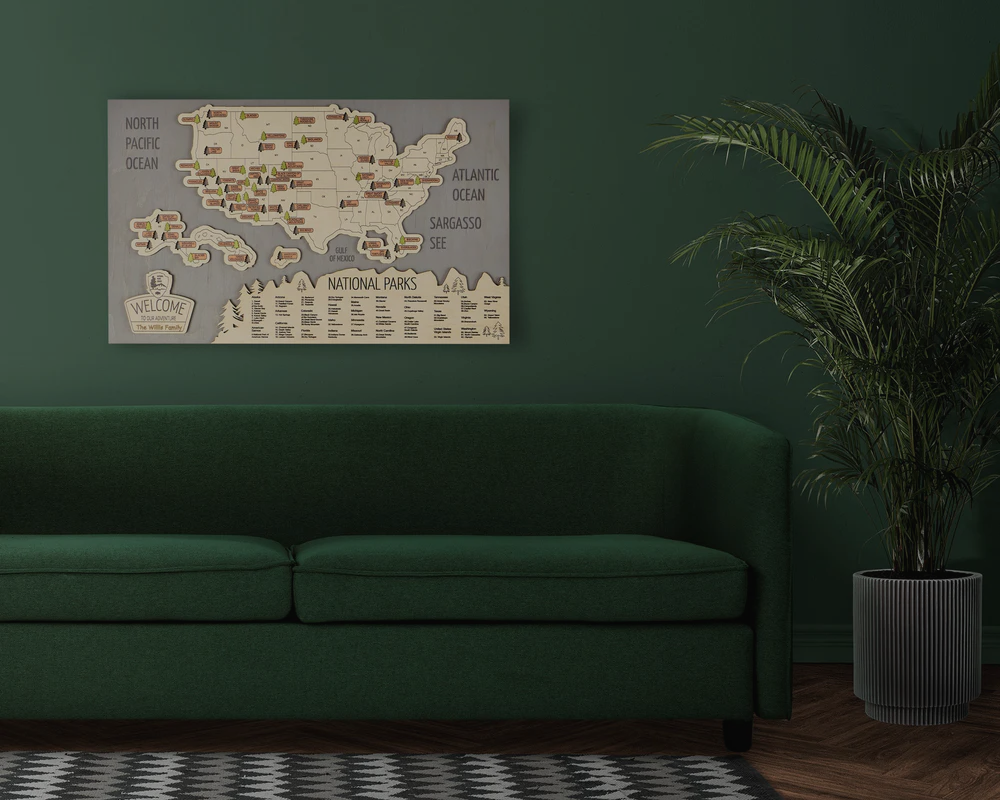
If Glacier is on your list, a wooden national parks tracker map lets you mark it off alongside the other 62 U.S. national parks.
13. Why is it called "Glacier" National Park?
The park is named for the glaciers that carved its mountains and valleys over thousands of years, not primarily for the glaciers that remain today.
At the time of establishment in 1910, the park held far more named glaciers than the 25 that remain now. But the name refers as much to the dramatic U-shaped valleys, cirques, and glacially polished rock the ice left behind as it does to the ice itself — geological evidence of glaciation is visible throughout the park, even in areas where the ice is long gone.
14. Is Glacier National Park in Canada, or does it border it?
Glacier National Park is entirely within the United States, in Montana, but it directly borders Canada's Waterton Lakes National Park in Alberta.
In 1932, the two parks were jointly designated the Waterton-Glacier International Peace Park, the world's first park of its kind, symbolizing peace between the two countries. Both parks later received UNESCO World Heritage Site status in 1995. Visitors can cross between the two, but doing so requires passing through an official border checkpoint with standard passport/ID requirements.
15. What animals live in Glacier National Park?
Glacier National Park is home to grizzly bears, black bears, mountain goats, bighorn sheep, moose, elk, and mountain lions, along with more than 260 recorded bird species.
 Mountain goats and bighorn sheep are especially common sightings near Logan Pass and Hidden Lake Overlook, while moose are more often spotted near lower-elevation wetlands and lakeshores such as Fishercap Lake in the Many Glacier area. The park's wildlife diversity is part of what makes it one of the most ecologically intact regions in the Lower 48 — few ecosystems in the continental U.S. still support their full range of historic large predator and prey species.

Laat een reactie achter
Deze site wordt beschermd door hCaptcha en het privacybeleid en de servicevoorwaarden van hCaptcha zijn van toepassing.