












The least visited national park in the US is Kobuk Valley National Park in Alaska, which recorded just 7,786 recreation visits in 2025. It is followed by Gates of the Arctic, Lake Clark, Isle Royale and Katmai. Five of the ten least visited national parks are in Alaska, and the least visited park in the Lower 48 is Isle Royale in Michigan. If you want a quiet park you can reach by car, the least visited is North Cascades in Washington.
These numbers come from the National Park Service's official visitor statistics for calendar year 2025, the most recent full year of data, published in March 2026. For scale: the entire park system recorded about 323 million recreation visits that year, and Great Smoky Mountains alone drew more than 11.5 million. The ten least visited national parks together account for roughly 0.5% of all national park visits.
Low numbers almost never mean a park is not worth visiting. They usually mean it is hard to reach, open for only part of the year, or expensive to get to. This guide shows where each of these parks is, why so few people go, and what it takes to visit them.
The Least Visited National Parks on the US Map
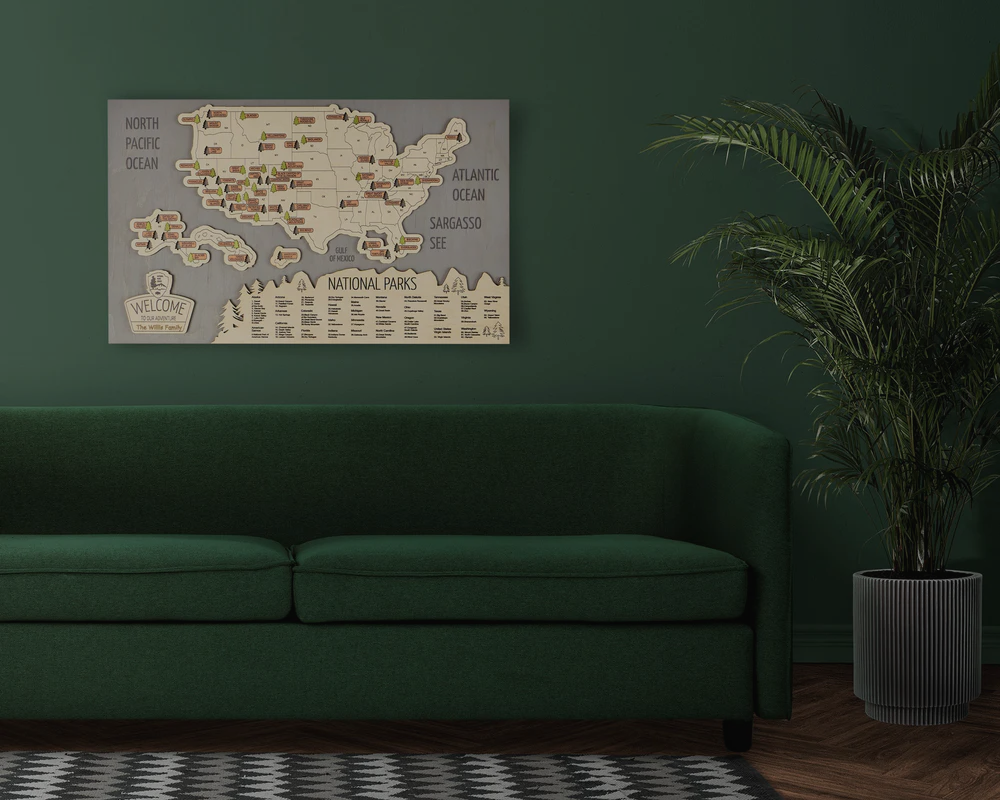
The map below shows all 63 national parks, with each dot sized by its annual visits. The ten least visited parks are highlighted. The pattern is clear at a glance: the quietest parks cluster in Alaska, on islands, and in remote corners of the West, far from interstates and major airports.
Seeing the parks this way also explains the list better than any ranking. Almost every park at the bottom is separated from the road network by water, mountains or tundra. If you are building your own bucket list, it is the same map to start from. Our US national parks map lets you mark each park as you visit it, including the hard-to-reach ones.
The 10 Least Visited US National Parks, Ranked
|
Rank |
National park |
State |
Visits (2025) |
How you get there |
|
1 |
Kobuk Valley |
Alaska |
7,786 |
Air taxi only |
|
2 |
Gates of the Arctic |
Alaska |
14,923 |
Air taxi, or hike in from the Dalton Highway |
|
3 |
Lake Clark |
Alaska |
19,778 |
Small plane only |
|
4 |
Isle Royale |
Michigan |
29,091 |
Ferry or seaplane |
|
5 |
Katmai |
Alaska |
34,479 |
Flight + floatplane |
|
6 |
National Park of American Samoa |
American Samoa |
43,258 |
Flight via Honolulu |
|
7 |
North Cascades |
Washington |
46,925 |
Car + trail |
|
8 |
Dry Tortugas |
Florida |
89,355 |
Ferry or seaplane from Key West |
|
9 |
Wrangell-St. Elias |
Alaska |
108,840 |
Gravel road or small plane |
|
10 |
Great Basin |
Nevada |
161,210 |
Car (paved road) |
1. Kobuk Valley National Park, Alaska
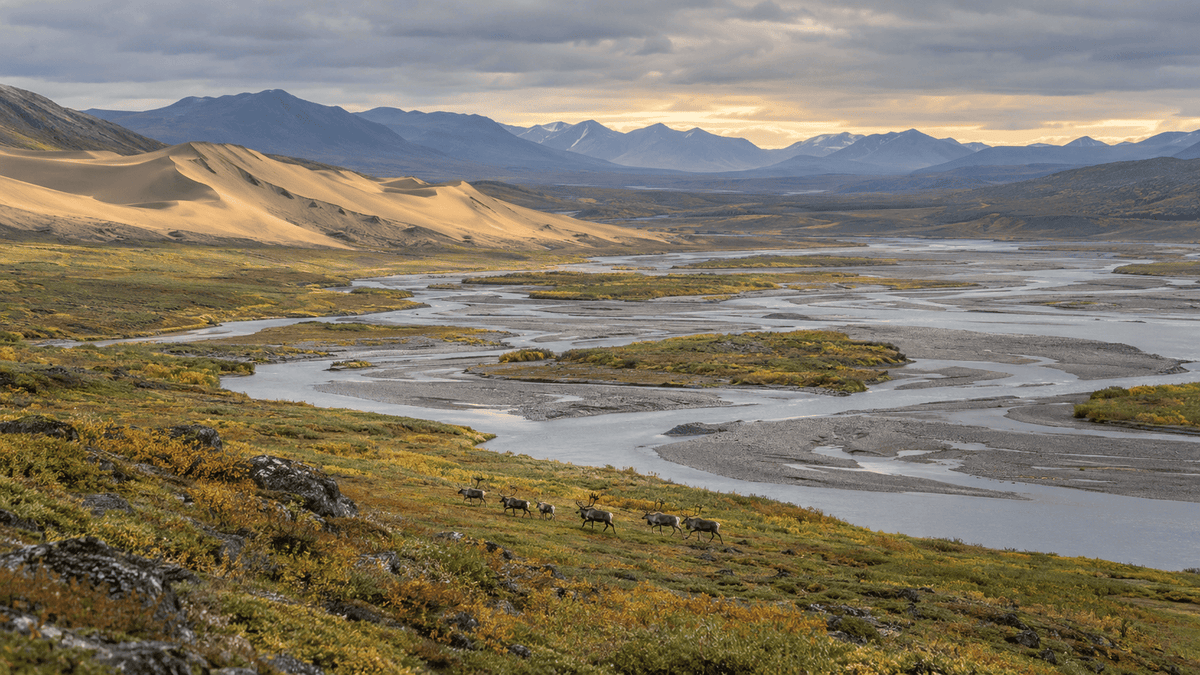
Kobuk Valley is the least visited national park in the US, with 7,786 visits in 2025, down from 17,233 the year before. It lies north of the Arctic Circle in northwestern Alaska and has no roads, no trails, no campgrounds and no cell service.
What draws the few who go is one of the strangest landscapes in the park system: the Great Kobuk Sand Dunes, Arctic sand dunes that rise up to about 100 feet above the tundra. Twice a year, the Western Arctic caribou herd migrates through the valley and crosses the Kobuk River.
- Getting there: fly commercially to Kotzebue, then charter an authorized air taxi into the park.
- Best time: summer for hiking and camping; late summer and early fall for the caribou migration.
- Who it's for: experienced, fully self-sufficient wilderness travelers, ideally with a guide.
2. Gates of the Arctic National Park & Preserve, Alaska
Gates of the Arctic recorded 14,923 visits in 2025. The park and preserve cover about 8.4 million acres of the Brooks Range, entirely north of the Arctic Circle, and contain no roads and no maintained trails. You follow rivers, ridgelines and caribou paths. The park also protects six designated Wild and Scenic Rivers, which makes it a classic destination for float trips.
- Getting there: most visitors fly from Fairbanks to Bettles or Anaktuvuk Pass, then take a bush plane into the Brooks Range. It is also possible to hike in from the Dalton Highway near Wiseman, which is the cheapest but most demanding route.
- Best time: mid-June to August; snow can return in late August.
- Who it's for: backpackers and river-runners with serious wilderness skills.
3. Lake Clark National Park & Preserve, Alaska
Lake Clark had 19,778 visits in 2025, even though it lies only about an hour's flight from Anchorage. It packs glaciers, turquoise lakes, two active volcanoes (Redoubt and Iliamna) and some of Alaska's most reliable brown bear viewing into one park. The coastal meadows at Chinitna Bay and Silver Salmon Creek are the main bear-viewing areas. Inland, Twin Lakes is home to the cabin of Richard Proenneke, the homesteader whose solitary life there became a well-known book and documentary.
- Getting there: no roads reach the park; everyone flies in by small plane, usually from Anchorage or Homer.
- Best time: June to September; bear viewing on the coast peaks in summer.
- Cost: a guided fly-in day trip for bear viewing often runs around $1,000 per person, which is the real reason visitation stays low.
4. Isle Royale National Park, Michigan
With 29,091 visits in 2025, Isle Royale is the least visited national park in the Lower 48. It is an archipelago of roadless islands in Lake Superior, reachable only by ferry, seaplane or private boat.
Isle Royale's numbers are low partly by design: the park closes completely from November 1 through April 15 because of extreme winter conditions on the lake. It is the only US national park that shuts down for the winter, so it records its visits in about half a year. Those who go come for multi-day backpacking, paddling and the island's famous wolf and moose populations, and many come back again.
- Getting there: passenger ferries run from Houghton and Copper Harbor in Michigan and from Grand Portage in Minnesota; a seaplane flies from Hancock, Michigan. Book ferries early for late July and August.
- Best time: late June to early September.
- Good to know: in late summer 2026, the park banned tent and hammock camping at four campgrounds because of increased wolf activity. Check current campground status before you plan a route.
5. Katmai National Park & Preserve, Alaska
Katmai recorded 34,479 visits in 2025, which is remarkable given the cost and effort involved. It is home to the world-famous brown bears of Brooks Falls, the stars of the park's online Fat Bear Week each fall, and to the Valley of Ten Thousand Smokes, an ash-filled valley created by the 1912 Novarupta eruption, the largest volcanic eruption of the 20th century.
- Getting there: fly from Anchorage to King Salmon, then take a floatplane to Brooks Camp. There are no roads into the park.
- Best time: July for bears catching salmon at the falls, and September for fat bears fishing in the river. Brooks Camp's visitor season runs roughly from June to mid-September.
- Cost: guided day trips from Anchorage or Homer often cost well over $1,000 per person. Brooks Camp lodging and camping are booked through lotteries and reservations months ahead.
6. National Park of American Samoa
The National Park of American Samoa recorded 43,258 visits in 2025, far above its usual level. It is the only US national park south of the equator and spans parts of several volcanic islands, where rainforest-covered mountains drop straight into coral reefs.
- Getting there: fly to Pago Pago via Honolulu. Flights are limited and expensive, which is the main barrier.
- Best time: the drier season, roughly June to September.
- Good to know: much of the park's land is leased from Samoan villages, so visitors are guests in a living culture. Ask before swimming or photographing near villages, and follow local customs, especially on Sundays.
7. North Cascades National Park, Washington
North Cascades recorded 46,925 visits in 2025, a 185% jump from 2024, when wildfires wrecked its season. It is the least visited national park you can drive to and lies less than three hours from Seattle. That is also the most misleading number on this list.
North Cascades is managed as a complex with Ross Lake and Lake Chelan National Recreation Areas. State Route 20, the scenic highway most visitors drive, runs through Ross Lake NRA, not through the national park itself. That means the drive-through traffic, including the famous Diablo Lake overlook, is counted in the recreation area. The national park proper only counts people who enter its roadless wilderness on foot. The landscape repays that effort: more than 300 glaciers, jagged peaks and empty backcountry trails.
- Getting there: drive SR 20 (the North Cascades Highway), then hike in from trailheads such as Cascade Pass.
- Best time: July to September. SR 20 closes seasonally in winter because of avalanche danger.
8. Dry Tortugas National Park, Florida
Dry Tortugas recorded 89,355 visits in 2025, and it is the clearest proof that "least visited" does not mean "unpopular." The park sits about 70 miles west of Key West, and about 99% of it is open water. Its centerpiece is Fort Jefferson, a massive 19th-century brick fort surrounded by clear water that is excellent for snorkeling.
- Getting there: the official ferry from Key West or a seaplane. The bottleneck is the number of seats, not interest: the ferry often sells out months in advance, and the small campground is hard to book.
- Best time: winter and spring for calm, dry weather. Summer and fall bring hurricane season.
9. Wrangell-St. Elias National Park & Preserve, Alaska
Wrangell-St. Elias recorded 108,840 visits in 2025. At about 13.2 million acres, it is the largest national park in the US, bigger than several states. It contains 9 of the 16 highest peaks in the country, and it is one of the few Alaska wilderness parks you can drive into.
- Getting there: drive the unpaved McCarthy Road (about 60 miles of gravel) to the footbridge near McCarthy, then walk or take a shuttle to the historic Kennecott copper mine and the Root Glacier. The Nabesna Road reaches the park's northern side. Small planes serve both areas.
- Best time: June to early September.
10. Great Basin National Park, Nevada
Great Basin rounds out the list with 161,210 visits in 2025, and it is the easiest park in the bottom ten to visit: you can drive in on paved roads. It lies in eastern Nevada off US Highway 50, nicknamed "the Loneliest Road in America," which explains a lot about the visitor count.
Great Basin combines 13,063-foot Wheeler Peak, groves of ancient Great Basin bristlecone pines (among the oldest living trees on Earth), and the guided tours of Lehman Caves. It is also an International Dark Sky Park with some of the darkest night skies in the country.
- Getting there: drive via US 50 or NV 487 to the town of Baker; the nearest major airports are Salt Lake City and Las Vegas, about four to five hours away by car.
- Best time: June to September for the Wheeler Peak Scenic Drive and alpine trails; Lehman Caves are open year-round.

Least Visited National Parks You Can Drive To
Most of the ten parks above require a plane, a ferry or both. If you want the quietest parks you can reach by car in the Lower 48, this is the list, based on the same 2025 NPS data with island parks excluded:
|
Rank |
National park |
State |
Visits (2025) |
|
1 |
North Cascades |
Washington |
46,925 |
|
2 |
Great Basin |
Nevada |
161,210 |
|
3 |
Voyageurs |
Minnesota |
206,326 |
|
4 |
Guadalupe Mountains |
Texas |
206,423 |
|
5 |
Black Canyon of the Gunnison |
Colorado |
250,086 |
|
6 |
Congaree |
South Carolina |
287,833 |
|
7 |
Petrified Forest |
Arizona |
315,951 |
|
8 |
Pinnacles |
California |
343,208 |
|
9 |
Carlsbad Caverns |
New Mexico |
410,778 |
|
10 |
Great Sand Dunes |
Colorado |
432,498 |
A few of these deserve special mention:
- Voyageurs (Minnesota): you can drive to its visitor centers on Rainy Lake, Kabetogama Lake and Ash River, but much of the park is water, so the real experience is by boat, canoe or houseboat, or in winter along the plowed ice roads.
- Guadalupe Mountains (Texas): home to Guadalupe Peak, the highest point in Texas at 8,751 feet, and to McKittrick Canyon, one of the best fall color hikes in the desert Southwest. Carlsbad Caverns is about 40 minutes away, so it is easy to combine the two parks in one trip.
- Black Canyon of the Gunnison (Colorado): one of the steepest, deepest canyons in North America. The Painted Wall, at about 2,250 feet, is the tallest cliff in Colorado, and the South Rim Road gives you the views without a strenuous hike.
- Congaree (South Carolina): the largest remaining old-growth bottomland hardwood forest in the Southeast, explored on an easy boardwalk loop about 30 minutes from Columbia. In late spring, its synchronous fireflies are so popular that viewing requires a lottery permit.
Why These Parks Get So Few Visitors
Almost every park on the list has the same few reasons behind its low numbers:
- No road access. Kobuk Valley, Gates of the Arctic, Lake Clark and Katmai can only be reached by air. Isle Royale and Dry Tortugas require a boat or seaplane. Every extra flight or crossing adds cost and filters out casual visitors.
- Short seasons. Isle Royale is closed half the year, and the Alaska parks have realistic visiting windows of only a few summer months.
- Cost. Air taxis, floatplanes and guides mean a single day in some Alaska parks can cost more than a week at a road-accessible park.
- How the NPS counts visits. Official figures count recreation visits within a park unit's boundaries, and boundaries matter. North Cascades is the clearest example: the highway and its most-photographed viewpoints belong to a neighboring recreation area.
- One-off events. Wildfires, ferry problems and staffing shortages can swing a small park's numbers dramatically from one year to the next. The 43-day federal government shutdown in fall 2025 also reduced staffing and services at many parks during October and November, so single-year rankings at the bottom of the list should be read with that in mind.
Least Visited vs. Least Crowded: What's the Difference?
"Least visited" and "least crowded" are not the same thing, and the difference matters when you plan a trip.
Least visited is a yearly total. Least crowded is how busy a park feels on the day you are there. A park with low annual numbers can still feel busy: Dry Tortugas has fewer than 100,000 visitors a year, but they all arrive on a limited number of boats and planes, so Fort Jefferson can feel full at midday. Katmai's Brooks Falls viewing platforms have waitlists in peak salmon season. Meanwhile, a large, popular park can feel almost empty if you go in the off-season or walk a mile away from the main viewpoints.
If your goal is solitude, the most reliable approach combines two things:
- Pick a park with low visitation that you can actually reach, such as Great Basin, Guadalupe Mountains, Black Canyon of the Gunnison or Congaree.
- Go outside its peak season, and on weekdays. Many popular parks are least crowded in late fall and winter; see our guide to the best national parks to visit in November for examples.
Are the Least Visited National Parks the Least Popular?
No. The least visited national parks are not the least popular in the sense of being least loved or least worth seeing. Their numbers reflect access, cost and season, not how people rate them.
Several of them have waiting lists and lotteries: Dry Tortugas ferry seats, Brooks Camp lodging at Katmai, and firefly viewing at Congaree. Isle Royale is known for an unusually loyal following of return visitors. For many park travelers, these are the most prized parks to collect precisely because so few people make it there.

How to Plan a Trip to a Remote National Park
Visiting the most remote parks on this list is a different kind of trip from driving to a visitor center. A few rules apply to all of them:
- Book transportation first. Air taxis, floatplanes and ferries have limited seats and fill up early; lodging and permits follow from your transport dates.
- Plan to be self-sufficient. In the Alaska parks there are no stores, no marked trails and often no shelters. Carry food, water treatment, bear-resistant containers and emergency communication, because there is usually no cell service.
- Build in weather days. Bush planes do not fly in low clouds or high winds, and delays of a day or more are normal. Never book a tight connection home.
- Consider a licensed guide or outfitter. For Kobuk Valley, Gates of the Arctic and Lake Clark, a guide makes the trip safer and often simpler logistically.
- Check the park's Alerts page on nps.gov before you go, since closures, campground restrictions and service changes are common in small, remote parks.
Quiet Parks Closer to Home
Not every quiet outdoor trip needs a bush plane. State parks are often the least crowded option of all, and many protect landscapes every bit as striking as nearby national parks. If you want to track the parks in your own state alongside the national ones, our map of national parks by state collection covers state parks across all 50 states.
Collect the Rarest Parks on Your Map
Among national park travelers, the least visited parks are the ones everyone asks about. Kobuk Valley, Gates of the Arctic or Isle Royale are the hardest parks to add to a list. When you do, mark them on a wooden national parks map or our National Parks Travel Tracker, and let the rarest parks stand out on your wall. For more background on the park system, see how many national parks are in the US and which state has the most national parks.

Hinterlasse einen Kommentar
Diese Website ist durch hCaptcha geschützt und es gelten die allgemeinen Geschäftsbedingungen und Datenschutzbestimmungen von hCaptcha.